Agudat Israel
Agudat Israel (Hebrew: “Union of Israel”) was an Orthodox party founded in 1912 at a congress in Katowice. Its creation was a reaction to the spiritual, political, and religious fragmentation of Jewry. The aim of AI was to preserve the foundations of the Jewish religion and traditions by strengthening the religious observance of Jews. The founders of AI considered it necessary to resolve the Jewish question and its related problems in the spirit of the Torah. The clergy played a leading role in the organization's activities.
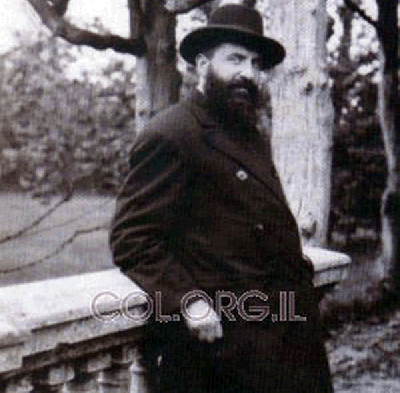
At the founding of AI, the rabbi of Dvinsk (Daugavpils), Meir Simcha Katz-Kagan (1843–1926), was invited to the founding congress and, although his health prevented him from attending the congress in Poland, he was inducted into the Council of Torah Sages of the International Union of Agudat Israel, in which he served until the end of his life.
By the late 1920s, AI organizations were active in 25 countries and united 500,000 people. However, AI was unable to become a universal organization. First, the ultra-Orthodox did not join it. Second, AI's rigid anti-Zionist orientation did not suit moderate Orthodox circles, which in 1922 in Poland founded Poalei Agudat Israel, an organization that took a more tolerant position toward Zionists.
The history of the AI party in Latvia began during the First World War. One of the main initiators of the Orthodox Jewish movement here was M. Dubin (1889–1956), who was a member of the governing bodies of the international AI organization and played a prominent role within them.
In independent Latvia, the AI party (often simply called “Aguda” here) was registered in late April 1920. It sought to unite the Jews of Latvia, to spread and protect Judaism, and to raise the next generation in the spirit of the Torah. AI's program also envisioned aligning the activities of Jewish institutions with the teachings of the Torah, fighting for the observance of the Sabbath rest, and organizing life on religious foundations. The Latvian AI was an assertive Orthodox organization that sought to infuse religion into every aspect of Jewish life. The party's program aimed to ensure the leading role of the synagogue and clergy in public and political life, attesting to the clerical character of the organization. In 1931, AI began publishing the weekly newspaper Unzer Shtime (“Our Voice”), in which its ideology was promoted.
AI represented in Latvia the interests of a segment of the Jewish bourgeoisie that collaborated with right-wing Latvian organizations; more than once in the Constituent Assembly and the Saeimas, its representatives voted alongside the Latvian Farmers' Union. The party was distinguished by its principled rejection of leftist tendencies — from Communists, Social Democrats, and the Bund to left-wing Zionism.
AI was also negatively disposed toward Zionism in general. Before the Second World War, AI waged fierce polemics against the Zionists. The Agudists considered the Zionist movement to be destructive, and viewed the way of life and culture of Zionist settlements in Palestine as harmful to the Jewish way of life. Therefore, they opposed any joint activity of religious and non-religious Jews within the World Zionist Organization. Only after the Nazis came to power in Germany did the leaders of the international AI gradually begin — inconsistently — to coordinate their position on British policy in Palestine with the program of the Zionist Organization. And only at the height of the Holocaust did AI finally support the Zionist program for the creation of a Jewish state in Palestine. In 1947, the international AI transformed from an anti-Zionist party into a non-Zionist one. The Latvian AI in no way deviated from these principled positions of the international AI union regarding the Zionist movement, which was the most influential socio-political current in Latvian Jewry.
The Orthodox Jews of Latvia had principled disagreements with the local Zionist movement on several issues. First, the Agudists differed from the Zionists on the national question. The Orthodox — like the Zionists — considered antisemitism inevitable and inescapable, and therefore believed it necessary to learn to adapt to circumstances. The Agudists saw salvation for Jewry in faith and ritual observance, in the study of the Torah. Consequently, the party was loyal to any regime that understood the significance of religion for maintaining stability in the country. AI was also characterized by so-called quiet diplomacy, based on the tactic of intercession (shtadlanut) aimed at neutralizing the greater evil. Second, AI differed from the Zionists — and not only from them — in its interpretation of cultural-national autonomy. In the latter, according to AI, religion should dominate; that is, cultural-national autonomy for them meant religious autonomy. Without this feature, autonomy held no interest for the Agudists. This position was rejected not only by Zionists but also by part of the bourgeois groups and left-oriented factions such as the Bund. Third, the Agudists denied the possibility of creating a Jewish state in Palestine and therefore consistently resisted any attempts to revive Jewish statehood in Palestine without “divine intervention.” Fourth, the disagreements with the Zionists concerned the nature of Jewish colonization of Palestine. The ideologists of the Latvian AI understood colonization of Palestine mainly as care for the religious piety of the Jews and settlers there. Fifth, the Orthodox diverged from the Zionists in their assessment of the coup of May 15, 1934. The elimination of democracy as such concerned the Agudists little. The AI leadership welcomed the coup, since the new regime took a positive view of the synagogue. The authorities found it convenient that the Jewish Orthodox had always been intolerant of materialist rationalism, hostile toward leftist tendencies, and opposed to modernism in all its forms — assimilation, liberalism, or Zionism. Moreover, AI members showed no particular interest in non-Jewish life unless it significantly affected Jewish life. After the coup, spiritual control over Jewish life in Latvia was ceded to the clerics of AI, for whom the religious upbringing of the younger generation was a priority. On the school question, AI members considered the chief task to be preserving the religious-national character of the Jewish school, and acted in close cooperation with the rabbinate. The Agudists favored the introduction of religious studies in educational institutions and were the initiators of establishing yeshivas. Sixth, the Agudists considered Hebrew exclusively a liturgical language, so the Zionist plan for the revival of Hebrew appeared to them to be blasphemous. Finally, not all currents of Zionism in Latvia — Tze'irei Zion, socialist Zionists — were unanimous in their assessment of the clericalization of the Jewish school that the Orthodox carried out, especially after the coup.
When analyzing the relations between AI and the Zionists, one must keep in mind that the degree of Orthodox rejection of different currents in the Zionist movement was not uniform. With general Zionists and religious Zionists, the Agudists had more common ground than with left-wing Zionists and Revisionists. Moreover, the threat of fascism was driving Jews toward unity, and from the mid-1930s one can speak of a certain loyalty on the part of the Latvian Aguda toward Palestinian construction in its Zionist form. However, full mutual understanding was still far off.
The political confrontation sharpened relations between Agudists and Zionists in Latvia — especially the struggle for voters in elections at various levels. Here the confrontation of AI members against their opponents was extremely fierce. And the opponents were not to be outdone.
In the Republic of Latvia, AI was an influential organization. Its representatives were members of the People's Council, the Constituent Assembly, and all the Saeimas of Latvia. Yet it must be said that the influence of this party was based not so much on its ideology as on the popularity of its leader M. Dubin — popularity that stemmed not so much from the influence of Orthodoxy among the Jews of Latvia as from his active advocacy on Jewish affairs.
After the coup, the AI party was liquidated (1934) and the public organization Machane Israel (Camp of Israel) was created, which continued the work of the Orthodox party.
Literature: Volkovich B. Agudat Israel — a Jewish Religious Party in Latvia (1920–1934) Jews in Daugavpils. Book Two. Daugavpils, 1999. Pp. 82–95.