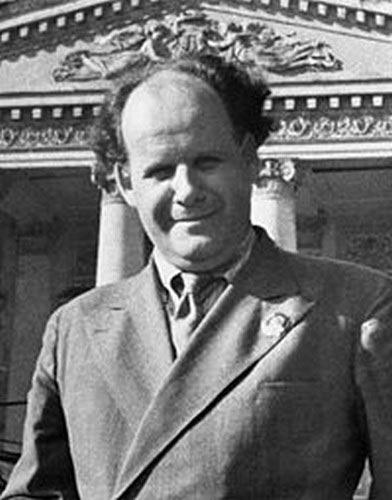
Eisenstein Sergei Mikhailovich (1898, Riga — 1948, Moscow) — Soviet film director, screenwriter, theorist of art. Born into the family of the Riga city architect, a court councillor of Jewish origin who had converted to Christianity; his mother was Russian, from a merchant family. From the age of 14, after his parents' divorce, Eisenstein lived with his father. In 1915–18, studied at the Institute of Civil Engineers (Petrograd). From 1918, worked on agitprop trains of the Red Army and actively participated in club amateur activities as director and set designer. In 1920, was head of the decoration department of the First Workers' Theatre of Proletkult (Moscow). In 1921–22, studied at the State Higher Theatre Direction Workshops under V. Meyerhold. From 1923, headed the theatre workshops of Proletkult; from 1928, taught at the State Technical College of Cinematography (later — the All-Union State Institute of Cinematography); from 1937 — professor. To familiarise himself with sound film technology, in 1929–32 Eisenstein (together with G. Alexandrov and E. Tissé) was sent on a mission to Western Europe and the USA. During the trip, he met G.B. Shaw, J. Joyce and F. Chaliapin, who wished to collaborate with him. It was planned that the directors would shoot a sound film in Hollywood, but these hopes were not fulfilled as the parties could not agree on the screenplay for ideological reasons. The main result of the trip was the material for the unfinished film epic “¡Que viva México!” shot in 1930–32 with funds from the American writer U. Sinclair, which laid the foundation of Mexican national cinema. His first independent productions at the Workers' Theatre of Proletkult — “The Sage” (after Ostrovsky's comedy “Enough Simplicity for Every Wise Man,” 1923), “Do You Hear, Moscow?” (1923) and “Gas Masks” (1924, both after plays by S. Tretyakov) — distinguished by the boldness of formal experiment, placed Eisenstein among the major innovative directors and drew him close to the LEF circle. In the journal “LEF” (No. 5, 1923), Eisenstein published his programmatic article “The Montage of Attractions,” in which he justified the social orientation of art. Already in his theatre work, Eisenstein found elements of his future creative practice — the montage of spectacular attractions, sudden transitions from drama to sharp sarcasm, the extreme intensity of feeling in each individual episode. His striving for semantic and emotional effectiveness, and for connection with mass audiences, led Eisenstein to cinema. The decisive stage of Eisenstein's dramaturgical work subsequently became the montage of the film. The “construction” method helped Eisenstein create a new type of film plot, at the centre of which is the image of the revolting masses. His 1924 film “Strike” opened up paths in world cinema toward the epic expression of the revolution theme. In the virtuoso montage elaboration of the action, the so-called “typage” method (“compressed biography”), documentary style, close-ups, rhythm and metaphorical juxtapositions of frames all played a significant role. In the film “Battleship Potemkin” (1925), Eisenstein created a five-part composition reminiscent in structure of classical tragedy. Many film historians link the final self-definition of cinema as an art form to this film. In 1926, the American Film Academy recognised it as the best film of the year. L. Feuchtwanger in the novel “Success” described the film and its impact on the audience in detail. In 1958, at the World's Fair in Brussels, “Battleship Potemkin” headed the list of the 12 best films of all time. The film “October” (1927), commissioned by the authorities for the tenth anniversary of the revolution and made together with director G. Alexandrov and cameraman E. Tissé, became a new stage in Eisenstein's work. Working on this film, Eisenstein developed the so-called theory of intellectual cinema: he believed that the montage of two frames gives birth to something third — a concept containing an evaluation of events. In 1967, the film was given a soundtrack with music by D. Shostakovich and re-released. The poetics of Eisenstein's films changed sharply at the turn of the 1930s under the increasingly tight control of party authorities, who combated any manifestations of aesthetic independence. His unfinished work “Bezhin Meadow” (1935–37, screenplay by A. Rzheshevsky and I. Babel; about the death of Pioneer Pavlik Morozov) is characterised by the attempt to develop individual characters, recognition of traditional forms of dramatic plot, and reliance on a literary screenplay. The authorities deemed the striving to create a great tragedy about the antagonistic struggle of the new against the old as a failure to understand the propagandistic tasks of art: the unfinished film was subjected to sharp criticism and removed from production. In “Alexander Nevsky” (1938; Stalin Prize, 1941), the artist attempted to combine creative exploration with the authorities' line of cultivating, in the pre-war years, a return to folk traditions, Russian roots and the heroism of the past. Eisenstein linked the epic structure of the film to the traditions of bylinas and folk tales; the visual solution echoed the fresco painting and architecture of Ancient Rus. The invasion of Rus by Teutonic knights was perceived by audiences as a warning about a possible attack by Nazi Germany. The film “Ivan the Terrible” — one of the peaks of world cinema (Part One — 1945; Stalin Prize, 1946; Part Two — 1944–45, released in 1958) — most fully embodied Eisenstein's concept of the synthesis of arts in cinema. Part Two of the film, in which Ivan, having achieved sole power through cunning and cruelty, is shown as a man doomed to loneliness and doubt, was subjected to devastating criticism sanctioned by I. Stalin and was not released. Eisenstein wished to save the film by attempting certain compromises, but never managed to complete this work. Eisenstein's films, which he made in an emphatically loyal manner to the Soviet authorities, are distinguished by the poeticisation of cruelty, which he treated as an iron necessity. At the same time, the party leadership never fully trusted Eisenstein and viewed him with great suspicion. Despite his inclination towards compromise, Eisenstein was not afraid, after Meyerhold's arrest, to hide the richest archive of his friend and teacher at his dacha. Eisenstein never publicised his Jewish origins; however, when the authorities invited him, among other well-known figures of Jewish culture, to speak at anti-fascist Jewish rallies in Moscow in 1941 and 1942, he could not refuse. Official Soviet sources deliberately concealed Eisenstein's origins, and sometimes intentionally falsified them, claiming that his father came from Baltic Germans. His wife, Pera Atasheva (née Fogelmann; 1900–65), was an actress, journalist and documentary film director.