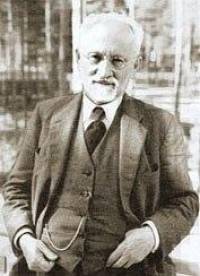
 Dubnov Simon Markovich (Shimon Meyerovich) (10.09.1860, Mstislavl, Mogilev Governorate, now Belarus — December 1941, Riga) — historian, publicist, civic figure.
He mastered the Russian language at the State Jewish School, which he entered in spring 1874. In June 1877, graduated from the local district school; attempts to enter the Jewish Teachers' Institute in Vilna and the real school in Dvinsk (1877–78) were unsuccessful. D. engaged intensively in self-education, devoting his main attention to the study of history, foreign languages and philosophy. In the summer of 1880, he came to St Petersburg, obtained a residence permit through fictitious documents and began contributing to the Russian-Jewish press. First publication: the article “Several Moments in the History of the Development of Jewish Thought” (April 1881, the journal “Russkiy Yevrey”); in the autumn of 1882, became a regular contributor to the major Russian-Jewish journal “Voskhod,” where from January 1883 his journalistic and literary-critical articles on Jewish themes appeared regularly; 1888 — the work “Introduction to the History of Hasidism.” In 1890, due to the refusal of his right of residence in St Petersburg, D. moved with his family to Odessa. From 1898, his works on Jewish history appeared: “Textbook of Jewish History” (1898–1901), “General History of the Jews” (1914). In 1906, D. returned to St Petersburg, actively participating in the public life of Russia at the end of the 19th and beginning of the 20th centuries: in 1906, he founded the Jewish People's Party (which existed in Russia until 1918); was one of the creators and leaders of the Union for the Achievement of Equal Rights for Jews in Russia (1906); headed Jewish literary and historical-ethnographic societies; edited the journal “Jewish Antiquity” (1909–18); was one of the editors of the “Jewish Encyclopaedia” (1908–13).
D. represented the history of the Jewish people as the history of the development of the Jewish national spirit; defined the Jewish people as “a people whose home is the whole world”; believed it had formed through adaptation to the conditions in which it lived, and in the diaspora had developed a special system and communal ideology. One community always stood out as more successful than the others in preserving self-governance, national creativity and spiritual independence, by virtue of which it became the centre of the Jewish people. Thus Eretz Israel was succeeded in this role by Babylon, then Spain, Germany, Poland and Lithuania. D. regarded Jewish religion as a means of self-protection for a people lacking the usual means of self-preservation available to other peoples. Therefore, in the period of emancipation, when the Jewish people enters an era of cooperation with the peoples of the world, religion loses its protective function, and the Jewish people must develop a secular culture. On this basis, D. rejected both Zionism (seeing it as an expression of pseudo-messianism) and assimilation, advocating for Jewish national-cultural autonomy and the creation of self-governing Jewish communities; he proclaimed the concept of autonomism, according to which Jewish national existence is possible in the diaspora (views set out in a series of articles “Letters on Old and New Jewry,” 1897–1902).
His main work — “World History of the Jewish People” — was first published in German in Berlin (1925–29).
From 1917, D. was a professor at the Department of Jewish History at the University of St Petersburg. He immediately and unequivocally rejected Bolshevik power; in April 1922, he left St Petersburg for Kaunas, where he was offered a professorship, and then moved to Berlin. After Hitler came to power (1933), he moved from Berlin to Riga.
In July 1941, Riga was occupied by the forces of Nazi Germany; D., together with thousands of other Jews, was placed in the ghetto (September 1941) and in December 1941 was included in a column of those condemned to death and killed in the outskirts of Riga. The Riga Jewish Secondary School bears the name of S. Dubnov.
Works: Dubnovs S. Žīdu vēsture. R., 1935, 1.–2. sēj.
Dubnov S.M. History of Jews in Europe: In 4 vols. Riga, 1936–1937.
Dubnov S.M. History of the Jewish People in the East: In 3 vols. Riga, 1939.
Dubnov S.M. Book of Life: Memoirs and Reflections: Material for the History of My Time. Vols. 1–3. Riga, 1934–1935, 1940.
Dubnov S.M. Letters on Old and New Jewry. St Petersburg, 1907.
Dubnov S.M. Modern History of the Jewish People. In 3 vols. Riga, 1937–1938.
Lit.: Outstanding Jewish personalities in Latvia / Text aut. G. Smirin. Riga, 2003. P. 14.
Smirin G. S.M. Dubnov on the Eve of the Holocaust: The Riga Years (1933–1941) Proceedings of the 11th Annual International Interdisciplinary Conference on Judaic Studies. Moscow, 2004. Pt. 1. Pp. 356–360.
Smirin G. Jews of Riga during the Nazi Occupation (1941–1944) Jews in a Changing World: Proceedings of the 5th International Conference, Riga, 16–17 Sept. 2003. Riga, 2005. P. 365.
FEYGMANIS Smirin REE